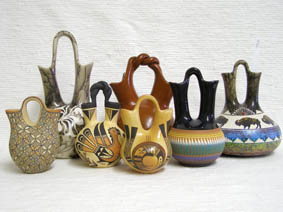
Native American Pottery
Kachina House carries Native American pottery handmade by artists across the Southwest, from hand-coiled Pueblo vessels to etched Navajo ceramic work and horsehair-fired pieces. Shop authentic Native American pottery online at Kachina House, the largest distributor of Native American arts and crafts, with pieces from Acoma, Hopi, Navajo, Zuni, and other tribal traditions across price ranges and styles.
Native American pottery is one of the oldest continuous art traditions in North America. Southwestern tribes developed distinct ceramic techniques tied to their land, clay sources, and cultural practices. That regional specificity is still visible in the work today.
Pottery Types at Kachina House
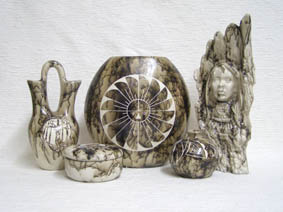
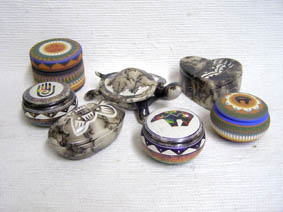
Horsehair pottery: Fired, removed from the kiln while hot, finished with horse hair applied directly to the surface. The hair burns on contact, leaving the characteristic dark lines and grey smoky areas.
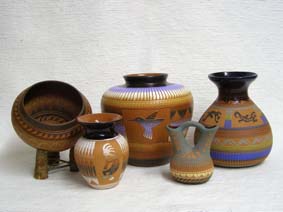
Navajo etched pottery: Made using the sgraffito technique, with designs incised through painted clay to reveal the raw surface beneath. Symbols include mountains, rain, lightning, prayer feathers, and migration patterns. Traditional Navajo pottery is handbuilt, fired outside in open pits, then dipped in hot pine pitch to seal the pieces.
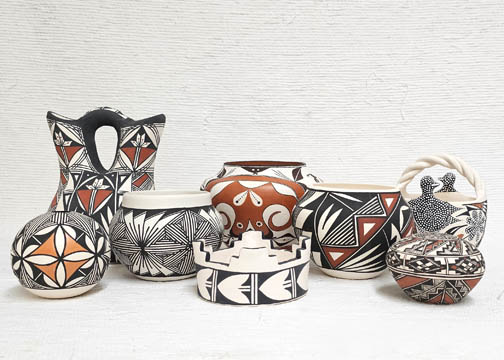
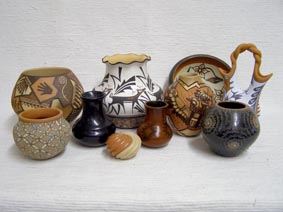
Acoma pottery: Hand-coiled work from one of the oldest continuously inhabited settlements in North America. Known for thin walls and fine black-and-white geometric patterning. The Acoma also do ceramic pottery using molds to create the shapes and handpainting the pieces.
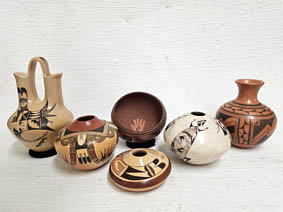
Hopi pottery: Made from local clay and natural pigments, fired outdoors in traditional methods. Surface designs reference clan symbols, katsina figures, and natural forms.
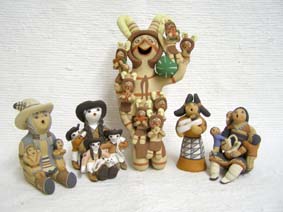
Storyteller figurines: Pueblo and Navajo handbuilt figures depicting an elder with children gathered around. A tradition developed at Cochiti Pueblo and adopted by potters across several communities.
Wedding vases: A traditional Pueblo form with two spouts joined by a shared handle, used in wedding ceremonies across Native American communities. Adopted widely in non-Native communities. These vases are available in many sizes and shapes, some are handbuilt and others are ceramic.
Specialty hand-coiled pottery: Built entirely by hand without a mold, coil by coil. The most labor-intensive method and the most variation between pieces.
Common Questions
- What is Native American pottery made from? Most Southwestern pottery uses local clay dug near the artist's community. Firing methods range from outdoor wood or dung fires to electric kilns, depending on the tradition.
- What is the difference between handbuilt and mold-poured pottery? Handbuilt pottery is constructed coil-by-coil without a mold. More labor-intensive, with greater variation between pieces. Mold-produced pottery creates the shape of the pot, freeing the artist to focus on etching and surface finishing.
- How do I know if Native American pottery is authentic? Check for a signature on the bottom of the piece. At Kachina House, every piece is sourced from artists across the Southwest. The Indian Arts and Crafts Act prohibits selling imitation Native American work as authentic.
- Is Native American pottery functional or decorative? It is decorative. Native-made pottery is not food-safe, nor is it sealed or fired at temperatures that would make it waterproof.
Kachina House is the largest distributor of Native American arts and crafts. Questions? Call toll free at 800-304-3290 or drop us an email.